I’ve written before about my great grandparents Harry and Mary Crook, and in particular Mary and the effects the Great War had on her as a mother. You can read my blog about her here:
You’ll probably be aware, if you’ve read my earlier family tales, that I have relatives from the Crook line living in Canada; cousins of my mother living in Saskatchewan where the seeds from England took root in 1910. By the power of social media and the occasional phone calls, the bridge with distant cousins Kris and Donna is still there. So it was a nice surprise when Kris dropped me a couple of emails containing letters from a century ago.
Kris seems to have had the responsibility of ‘going through’ some family papers; which is usually a source of more questions than answers, especially when there’s nobody left to give context to the meaning or background to the personalities named. In any case, Kris was aware of my interest in the Canadian branch of the tree and was kind enough to drop me the emails.
As a brief recap, two of the older brothers of my grandfather, Frank Crook, had emigrated to Canada before the Great War. Sydney came of age and made the leap in 1910, followed by Harry jr in 1913 when he left the army after seven years of service. My other blogs tell their tales, but Syd and Harry were swept up by the call to arms in 1914. Syd was killed in Flanders in 1916 with Harry’s war being ended by serious injury at Passchendaele in October 1917. A third brother, Herbert, was lost to the sands of Mesopotamia on army service in 1920.
Harry would resume life in Canada after the war, with brother Fred following on across the Atlantic soon after in 1920 to take up what had been left by his older brothers. For context, the Canadian branch of the family all emanates from Fred.
So back to the letters and information from Kris…

First of all, there was a picture I’d not seen before, which includes Harry and Mary Crook with four of their children: Irene, Frank (my grandfather) Violet, and Fred on the right. It’s undated, but judging their ages against their dates of birth I’d suggest it’s somewhere around 1918 or 1919, when Frank was aged about 9, and Fred about 17. It’s a guess, but we know Fred was off to Canada by 1920. I can recognise the location as Overa Cottages at Eccles, with the railway embankment behind.
Brother Herbert died in August 1920 on service in Mesopotamia, which makes the next piece of information all the more poignant. It’s a letter dated August 8th 1922, from Mary to Fred.
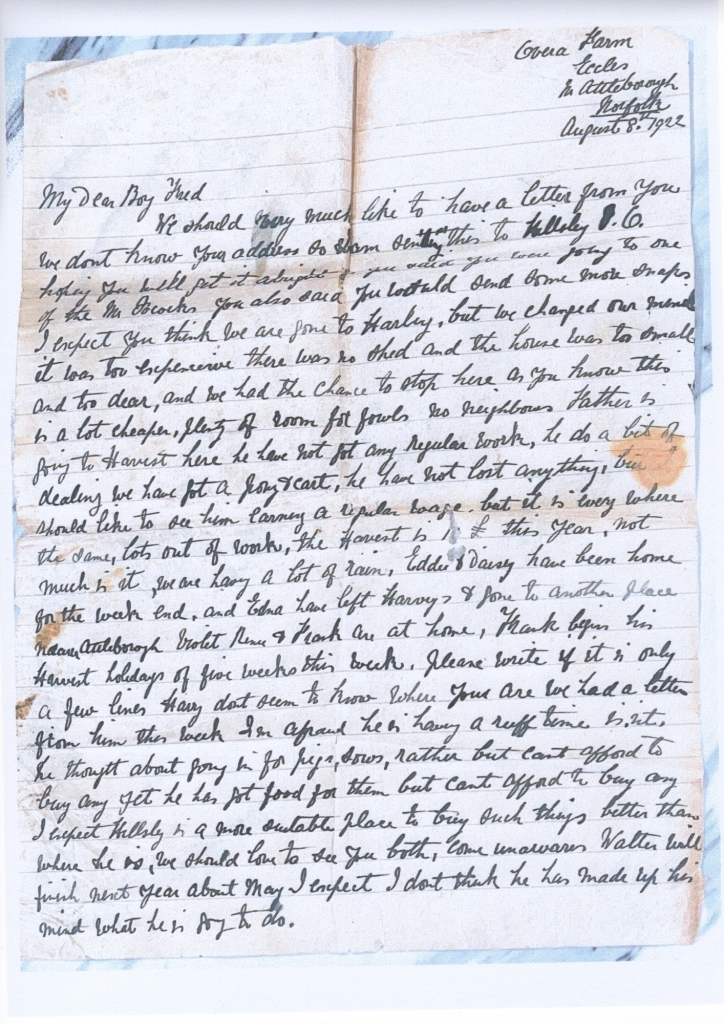

It’s an ordinary enough letter from a mother to a son, explaining that life at Overa Cottages was tough with no regular work for Harry and the humdrum of life as a tenant farmer’s labourer. These people had carved a living from labouring on the land – Harry had served in the Royal Artillery in the 1880s but was a farm labourer by trade and times were obviously hard as age began to creep up on him. There’s an explanation that they’d declined to take on a house in East Harling because they couldn’t afford it and it didn’t suit their needs. In any case, harvest time was coming and there was hope for work.
I know nothing about the motivations for Fred and his brothers to seek a new life in Canada, but I can only imagine poverty and a lack of paid employment was a major factor. Harry was 62 and Mary 54, so life with three dependent children would be tough and their older siblings had to cut their own path.
The poignancy comes from the words of a mother desperate to hear from a son on the other side of the world. I don’t know if Fred had communicated with home in the two years since his departure, but Mary had lost Sydney and Herbert to war and almost lost Harry. Now Fred was gone and her desperation for news comes across in her letter.
Sadly, we don’t know if she ever received a reply and if her plea went answered, as she was dead just two months later. My mother always said that Mary died from a broken heart. You can judge for yourselves.
The second letter is from great aunt Edna, again to Fred and dated February 1933. It breaks the news that Harry has died.
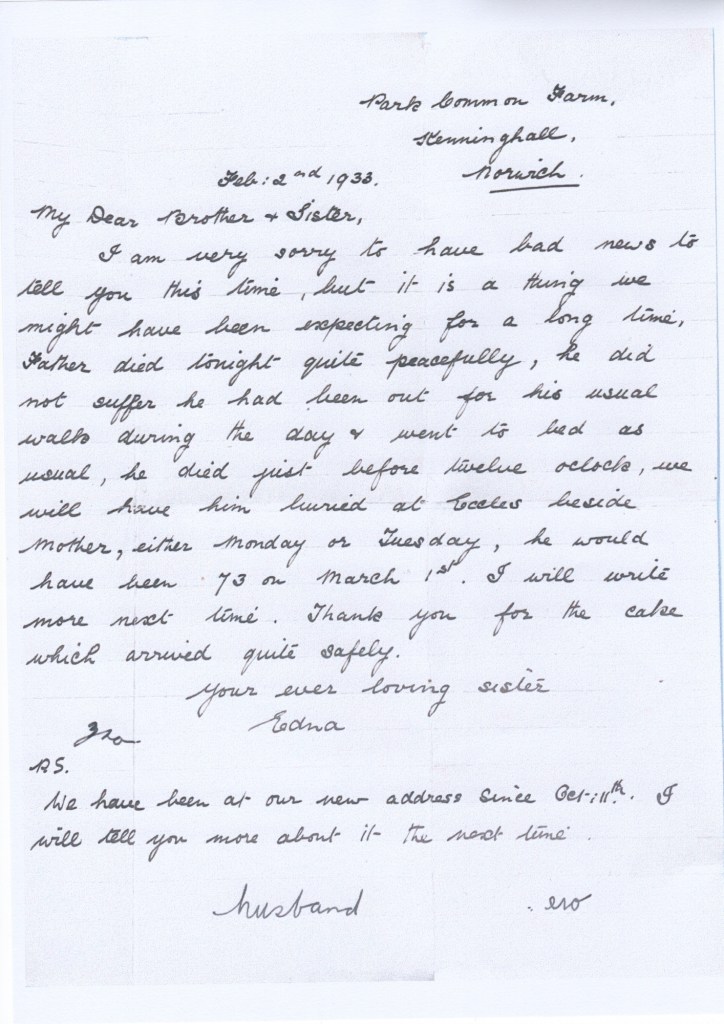
I know that at the end of his life for whatever reason, Edna was the one who took responsibility for caring for Harry at Park Common Farm in Kenninghall. I knew aunt Edna, and she was as tough as they come, so I can imagine her being organised enough to make sure Fred was aware, and I presume Harry would have also received a letter.
It’s an insight to a different time when communication was a real effort, and although I can only imagine the personalities of those from that generation, I’m glad they made the effort to keep the thin threads of family intact. Today we take communication for granted and it’s too easy to leave the message until tomorrow, or to communicate for the sake of it so that it becomes meaningless.
In any case, Fred lived a long and productive life, and his legacy thrives today in Saskatchewan.
For that reason I’m glad that Kris and Donna took the effort to keep the distant ties alive, and that one day, someone else will ask questions about the generations that went before. Maybe there will be more letters from the past; but I’m sad that our social media messages won’t survive like a letter written with a trembling hand three generations ago.
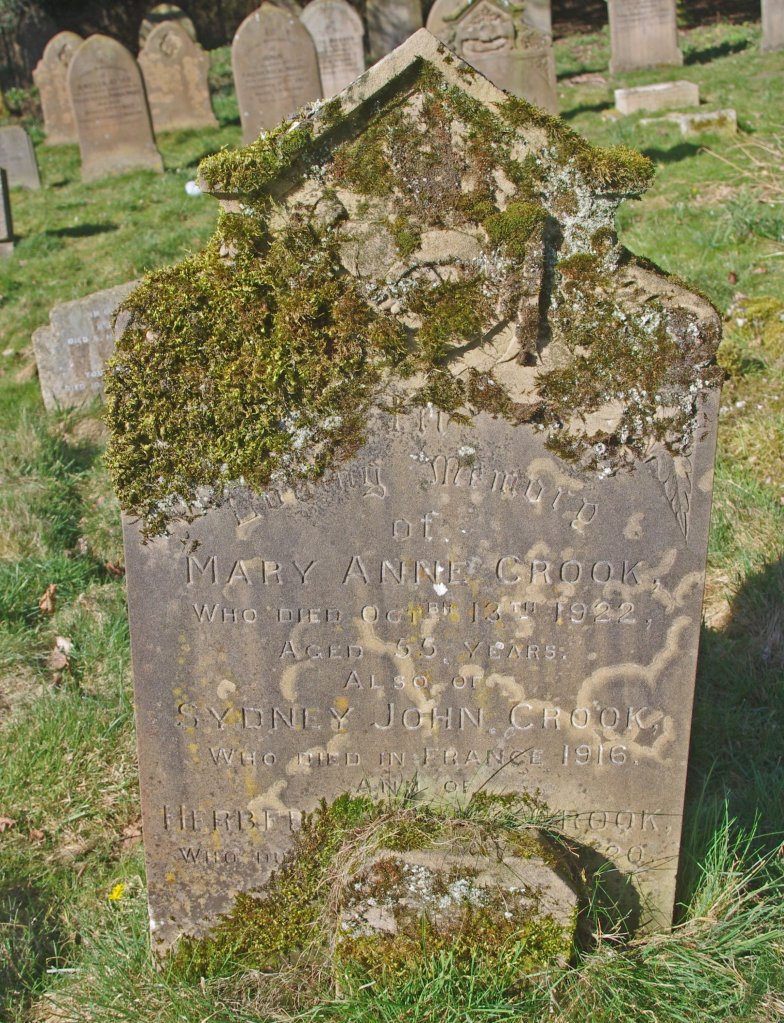
Next time I visit the grave of Harry and Mary, I’ll give their headstone a tap and reassure Mary that her memory carries on, more than a hundred years after she found her kin slipping away across the ocean.

 Farm Boys and Pioneers