The next journey into the family archives sees me going back to the wife’s kinfolk to look at her paternal great grandfather, John William Pearce. We’ve visited the Pearce family before in detail: Jack Pearce is covered in two blogs about his exploits as a gunner on Lancasters in World War Two, but now we look at his father in the Great War.
The tale of John Pearce is another frustrating one and again takes us in an unexpected direction at one point. My wife’s family have, at different times, all attempted to unravel the Pearce family line and like me, hit various roadblocks as far as facts go. Rummaging in the usual places has produced nothing much of anything definite, but it’s only recently something none of us were expecting has turned up. I’ll come back to that in due course.
Beginnings
We can start with the facts of John’s birth, and that he was born in January 1886 to Eliza Pearce at Thorpe next Norwich (Thorpe St Andrew as it’s known today) but we have no record of his father.
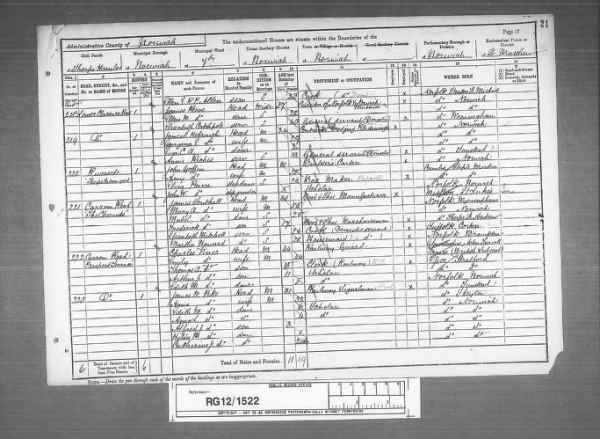
Young John is listed at Riverside, Norwich at the Station Yard aged 5, along with his mother, and as ‘step grandson’ to John and Amy Goffin. John Goffin is shown as a builder’s carter. We’ve never been able to unravel any more about this family dynamic, although Goffin is an ancient Norfolk name and was used as a middle name for Jack Pearce.

1901 sees Amy Goffin as widowed and living at Thorrold’s Buildings in Norwich. As far as I can tell, this is still in the vicinity of the station, near Foundry Bridge and Eliza and John are still there but none of the family are listed as employed. John is by now aged 15, but has been elevated to grandson rather than step-grandson.
Although we know nothing about John’s trade at this point, in April 1909 aged 23, he marries Maud Nichols and by 1911 they are living at 22 Dover Street with the beginnings of a family. We know very little about his circumstances, but clearly John is able to provide a living for Maude and baby daughter Joan as a shop assistant in a cycle shop.


However, looking through history sees us going back to 1910 and taking a departure from the expected narrative as we lead up to the wartime service of John. In researching soldiers, newspapers form an important source when official records are unavailable. Sometimes, other surprises turn up….
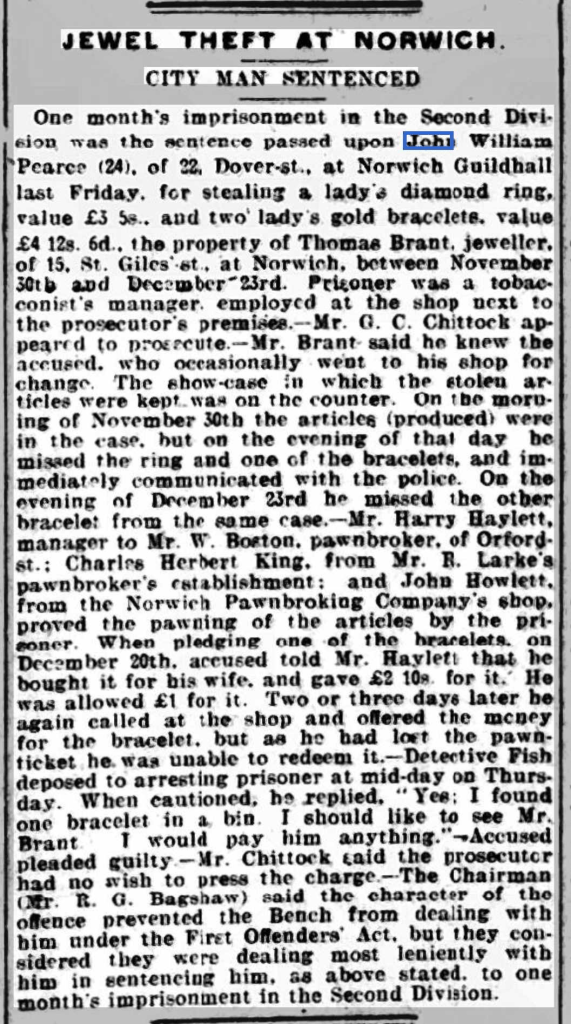
From the newspaper report from the Lowestoft Journal of October 1st 1910. It seems that John, newly wed and with a baby on the way in late 1909, committed two acts of theft from a Norwich jewellers in St Giles. Having pawned the proceeds, he was promptly identified and prosecuted. The report doesn’t tell us anything about mitigation, and John was committed to prison for a month – in the second degree meaning he was spared penal servitude or hard labour, and was segregated from the most serious offenders. I don’t know if he served the full term. Maybe the type of crime gives us an insight into his circumstances as much as his character. I just get the feeling that life was desperately tough for John and Maude with a baby due and all the uncertainty that brings.
But….
In October 1913 John was back in the news and back in employment when he was a witness in a case of bicycle theft from his employer, Hurn’s cycle shop on St Stephens. Maybe he had redeemed himself at last.

Military Service
So now we move to the crux of the blog, as always, the military service of John Pearce. So what do we know about his time in the military?


In short, the military records tell us very little other than that John served in the Mechanical Transport section of the Army Service Corps as Private M2/183467 and that by 1918 he was serving as a Lance Corporal. Unfortunately the records give us nothing about how or when he enlisted, or when and where he served overseas, although it seems entirely likely that as he’d had a background in the cycle trade he was probably mechanically proficient enough to be trained as a mobile fitter, or a despatch rider. We assume he had been demobbed by 1919 as he doesn’t appear as an absent voter.
The ASC was a huge corps, servicing the needs of a mobile army, but there is no clue as to which company or unit John was attached.
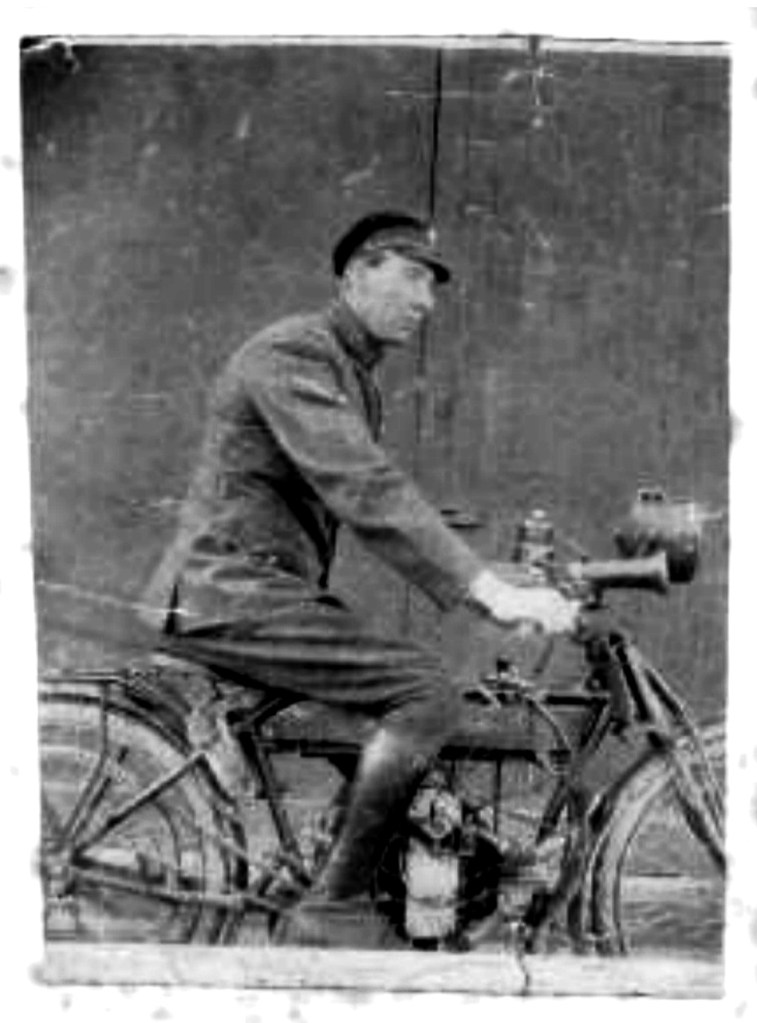
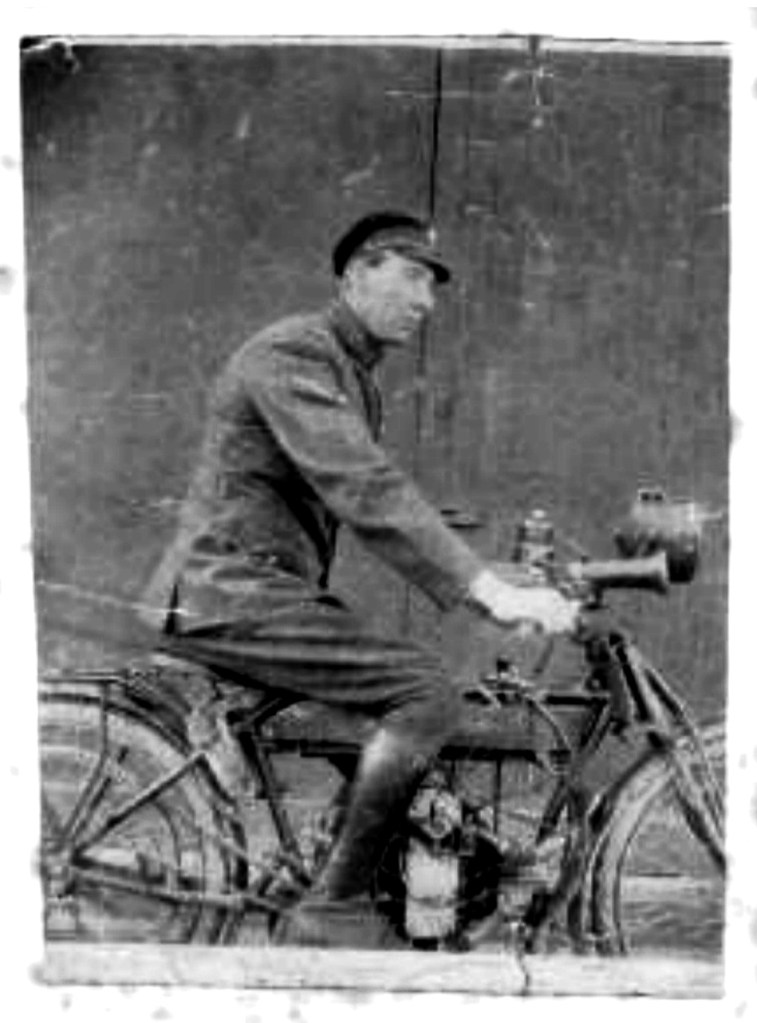
We do however have a picture of John in service. I’m not sure about the model of motorcycle; that’s another side project to decide if it’s a Triumph Model H or a Douglass or something else.
Determined to find out more, I reached out to Chris Baker, author of The Long, Long Trail and a renowned researcher who’s helped on other projects. Chris also concluded that there was very little information available to build a picture of John’s service. Chris was able to deduce that John was most likely called up to commence training between 1st & 5th June 1916 at Grove Park Depot in south London, but we don’t know if John was conscripted or was a volunteer in the Group Scheme of late 1915.
In any case, it is at Grove Park that John would have been tested for an aptitude in a given trade before undergoing basic military training and skills training before being sent to a unit. It’s reasonable to assume that he wouldn’t have been ready for deployment overseas until 1917, but we have no details from his medal records of when he went to a theatre of operations.
I could fill the page with a description of the role of the Army Service Corps, but we are really at the end of the line for sources. It would seem that John served out an unremarkable war devoid of drama or incident, and with no evidence of awards or recognition and no evidence of wounds or ill health.
I’m sure that if John had been discharged due to wounds he would appear on the rolls of the Silver War Badge. Equally, an injury or significant illness would likely generate a claim for a pension. The archives are silent.
He holds the War Medal and Victory Medal, which we still have. One funny aside is that when my father-in-law realised we wanted to frame them, he thought it would be helpful to put the original ribbons through the washing machine!
Dear reader, please don’t do this!


After the War
So having researched a mundane tale of family life in Norwich, a brush with the law, and an unremarkable war, what else did we find?
The 1921 Census sees John living at Bury Street, with John recorded as an unemployed clerk with the Norwich Incorporation, and with his young family. Times were hard after the war and clearly times were especially difficult for John as he appears to have been laid off.

The final surprise came in the form of another newspaper report from October 1924. John appears to be back in employment with the City, as he is a witness for the prosecution in a case of benefit fraud. He appears to be in a responsible job as a clerk managing welfare payments, and I hope he’d found some stability in his life.

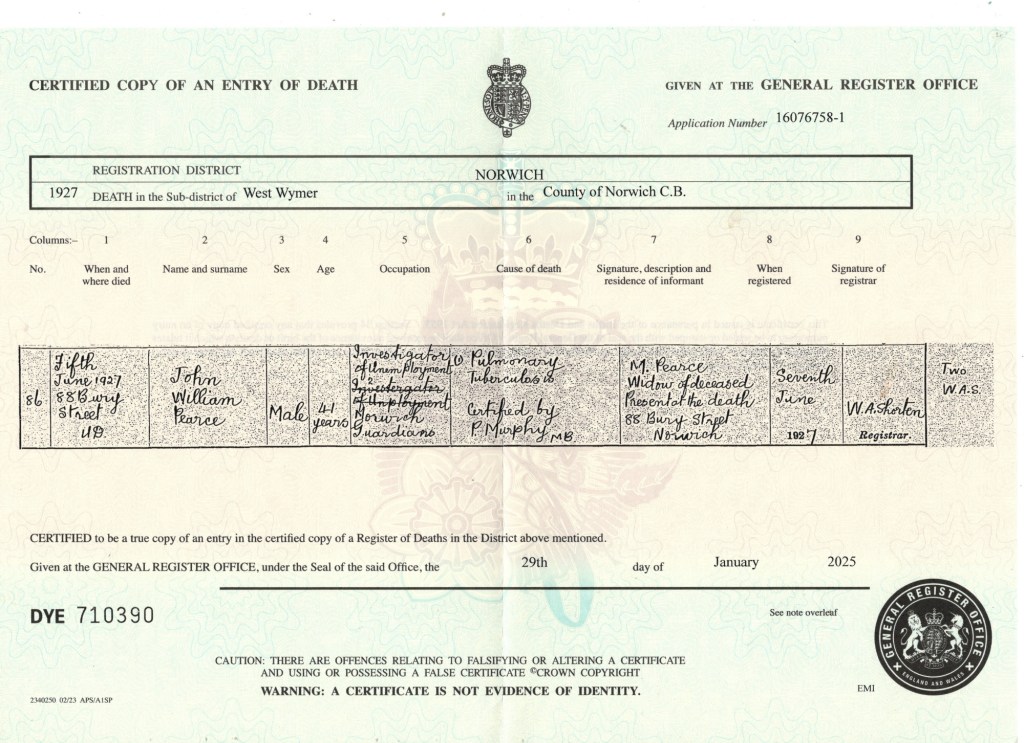
We don’t know much else about John’s life after that until his death in June 1927 aged just 41. Family lore suggests that he died from the effects of gas in the war, but as we’ve seen, there’s no record to show that he was exposed to gas at any point. I haven’t decided to spend the fee to obtain a death certificate, so conclusive facts will have to wait.
Although I’ve been unable to decipher John’s war due to lack of sources, I’ve been able to build a picture of a roller coaster of a life. John clearly came from very humble beginnings, and as a young man with a small family obviously had a difficult time in the early days of married life before the Great War put life on hold. We know he served, and I hope he did his bit willingly.
He would, I’m sure, be proud to know that the Pearce name carried on with his grandchildren and generations of great grandchildren spread across the globe.
The picture of him on his motorcycle is just the window into history that opens the imagination and continues the hope that one day we’ll find out more about him.
He is remembered every day.
Addendum
As always, the search carried on after I published the blog, and cousin Muriele ordered the death certificate for John which revealed his cause of death was pulmonary tuberculosis. We remain unsure if there were any grains of truth in his exposure to poisonous gas, but there simply aren’t any records to support this.

 Farm Boys and Pioneers