
I met Brian a year ago on a tour of the battlefields of France and Flanders, and as always on such tours, chat in the back of the minibus would turn to our shared stories of ancestors who’d fought in the Great War.
Brian had told me about his grandfather, David Wilson, and that family lore was that he’d served with a Scottish regiment, and was wounded in the war although precise details were a little sketchy. Cursory checks whilst dashing around Flanders in the rain quickly identified that a bit more research was needed, and we agreed to follow up once we got back to England.
As Brian promised, he sent me a few details about him, including a picture that was central to the family memory. The family is of Scottish descent, and as David Wilson was a Scotsman of the Kingdom of Fife, it should be of no surprise to see the picture of him above (on the right at the rear of the picture) with him proudly wearing a Glengarry. Certainly enough details to be getting on with to research a soldier of the great war.
It’s taken me a full year to commit the tale to a blog, but the research was prompt, and quickly revealed a different understanding of David Wilson and his war.
As is so often the case, David Wilson is a common name, and the first task was to identify the correct soldier. Genealogical records were the first point of call with birth, marriage and census records all helping narrow down the search.
David Wilson was born on June 4th 1892 at Lochgelly, Auchterderran, Fife to James Wilson and Anne Suttie. A mining family living in a mining village close to the pit.
Lochgelly was a tiny village, and it soon became clear that there were many men of that name from the immediate area who had served with Scottish regiments, and so guided by the picture, that was the focus. Frustratingly though, it seemed all would be more difficult than it first appeared.
A number of men of that name from that area, were killed in action, which narrowed the search, but what we needed was a clue amongst all the other similar names. Family history gave us the answer, and an address proved crucial.

What we did know as fact is that David married Isabella Cunningham Innes in September 1913, and it’s her family address of 61 Sligo Street, Lumphinnans that appears on the marriage record. Lumphinnans adjoins Lochgelly and was home to many pit workers from the local colliery. David was 21 and a coal miner, while Isabella was 18 and a pithead worker. I’m not sure if it’s Sligo Street or Mungal Street in the picture below, but either way, it gives a good impression of what Lumphinnans was like in 1913.
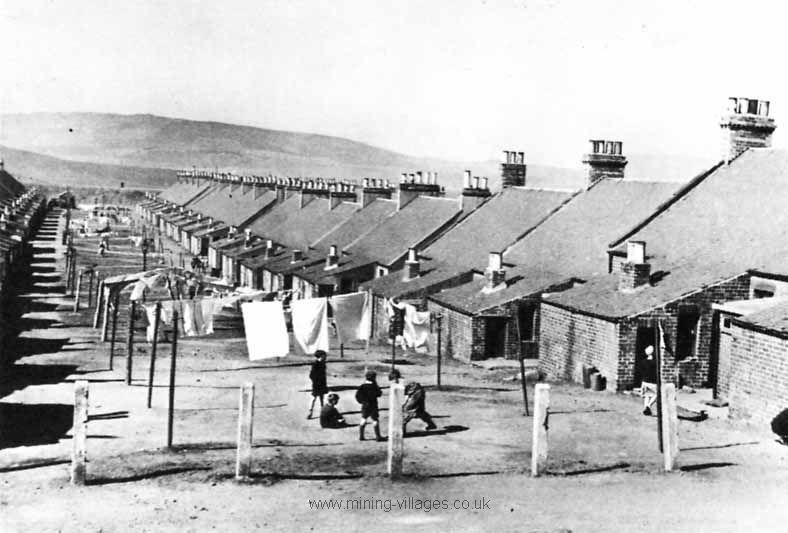

The coalfields of Fife are all long gone now, and the footprints of Lumphinnans as it was in 1913 have been overwritten by modern development; but this was the clue we needed.
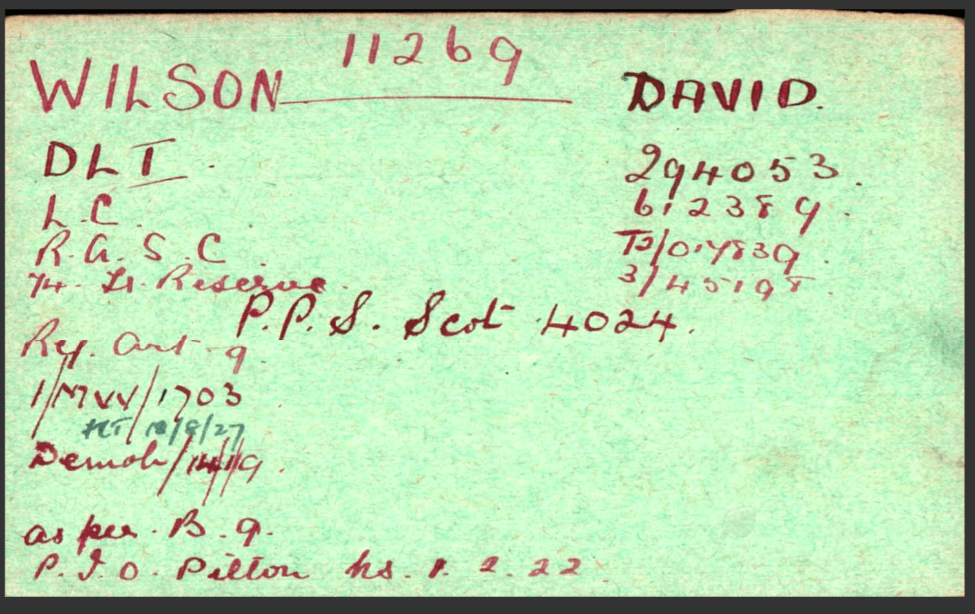
Searching service records identified postwar pension claims for a David Wilson of the Durham Light Infantry. The claims for anaemia and trench fever for Private 294053 Wilson were rejected, but crucially his address was given as 65 Sligo Street.
Could there really be two men of the same name living two doors apart serving as soldiers?
What we subsequently learned is that David Wilson married Isabella in 1913 and lived at her home of 61 Sligo Street, effectively marrying the girl next door, then later living at number 65 after the war.
What we have below is the 1921 Census records showing the Innes family still living at 61 with David and Isabella living at 65.


So having identified 294053 David Wilson as the right man, where did the research about this proud Scotsman take us?
If the man in the photograph proudly sporting the Glengarry is our David Wilson, what does the picture tell us?
What we have is a group shot of a number of men in a hospital environment, most of whom are wearing Scottish head dress.
I reached out to the renowned military uniform experts Professor Peter Doyle and Taff Gillingham for clues. Peter Doyle was of the opinion that the Glengarry was probably from the Argyll and Sutherland Highlanders. Taff identified the grey convalescent coat as dating from 1915 to mid 1916. Further conversation dated the VAD (Voluntary Aid Detachment) nurse uniform to 1915. Unfortunately I have no date for the picture to cross check the veracity of their opinions. So what of the official records?
This is where the hat becomes a red herring…


David first disembarked in France with the ASC on 12th July 1915, and his medal entitlement is the the 1915 Star, the British War Medal and Victory Medal.
What is clear from the records is that David Wilson has a Medal Index Card listing the regiments with which he served, and that he is on the Medal Roll for the Durham Light Infantry. What is also clear is the lack of Scottish regiments, and certainly no reference to the Argyll and Sutherland Highlanders. But what does it tell us?
The medal records show that David Wilson served with the following regiments with the attached service numbers:
Army Service Corps T2/017839
1/6th Battalion Cheshire Regiment 68685
17th Battalion Liverpool Regiment 248053
126th Company Labour Corps 612389
29th Battalion Durham Light Infantry 294053
Research tends to confirm that the rolls show the correct sequence of his service.
Army Service Corps service number T2/017839 appears to have been issued in October 1914 and suggests this is his time of enlistment. No attestation papers or Service Record survives.

Further searches reveal field hospital admission records that show ASC Driver T2/017839 David Wilson was attached to the 51st Field Ambulance as part of 17th (Northern) Division during 1916.
The Medal Index Card corroborates the date of embarkation of the 51st Field Ambulance from their war diary, as they can be seen setting sail from Southampton to Le Havre aboard the SS Inventor and SS Empress Queen on that date.
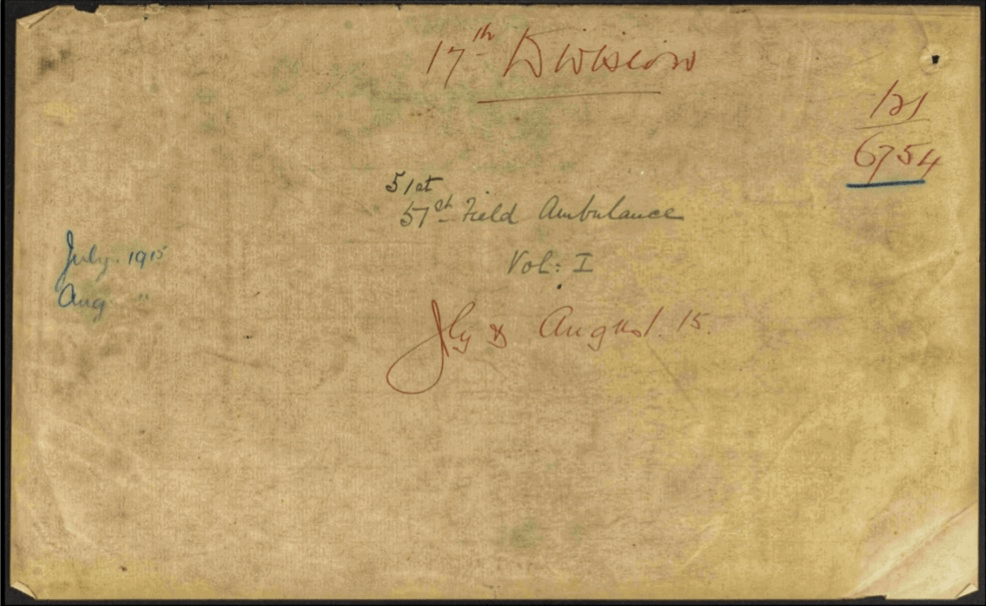
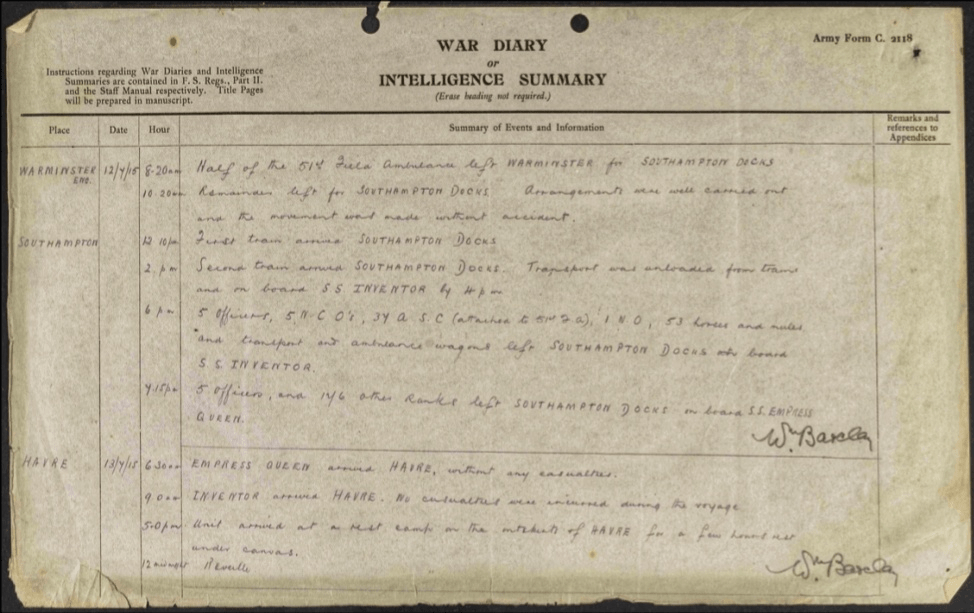
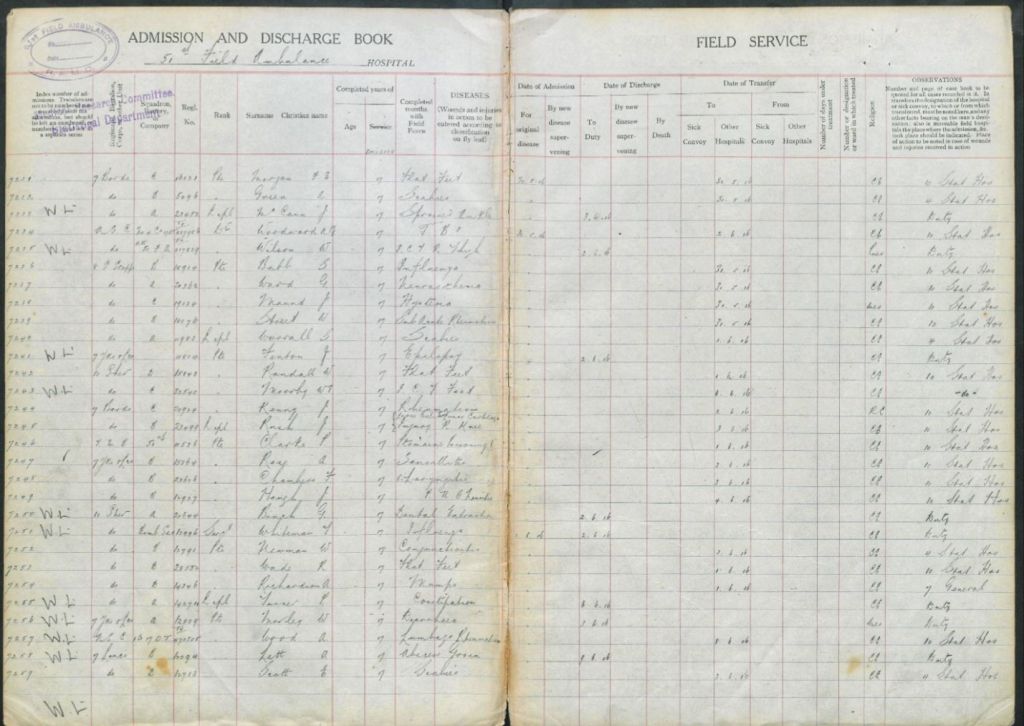

The 51st Field Hospital Admission records above show that T2/017839 David Wilson was briefly admitted to the hospital with minor conditions on 31 May and 22 November 1916 respectively, but this does not appear to be linked to his later unsuccessful pension claims.
We don’t know when he joined them, but sequencing similar numbers for men drafted to the 1/6th Battalion Cheshire Regiment, it would seem David Wilson moved to the regiment on or around 14th December 1917, so would have served all of 1915/16 with the ASC as a driver and left in late 1917.
There are no records showing his activity with the 1/6th Cheshire Regiment.
It is not yet known when David Wilson moved on to the 17th Battalion Liverpool Regiment and then the 126th Company Labour Corps. Labour Corps on the MIC suggests a man possibly unfit for frontline service, although many units were reduced from fighting battalions to Labour Corps units at the end of the war as the order of battle was continually reduced and reorganised.
The last entry, and therefore the unit he belonged to at war’s end when medals were allocated was for the 29th Battalion Durham Light Infantry.
The record shows he was eventually discharged to the ‘Class Z’ reserve and therefore theoretically fit enough to be subject to recall until the reserve was abolished in early 1920.
An entirely ‘English’ regimental service history does not explain though why the man identified in the picture would be wearing a Glengarry from the Argyll and Sutherland Highlanders as identified by Peter Doyle. It has been suggested that the 10th (Scottish) Battalion Liverpool Regiment wore a similar Glengarry to the Argyll’s, but there is no evidence to support David Wilson ever served in the Liverpool Scottish.
Also, I’ve been unable to find a record of David Wilson being issued a Silver War Badge for wounds, as his name doesn’t appear in the rolls.
So where does this leave our research, and more importantly, where does it leave the family history? As always, time plays tricks on the memory, and memories aren’t always built on truth.
What is of no doubt is that he served a full war with the 51st Field Ambulance attached to the 17th (Northern) Division, and we can only imagine what he would have seen as his unit cared for the dead and dying. Although he has no hospital records beyond the minor illness of 1916, it’s possible he could have been in poor health in 1917 and thereafter.
A summary of his Divisional history is extracted from The Long Long Trail here:
“This Division was established by the Northern Command in September 1914, as part of the Army Orders authorising Kitchener’s Second New Army, K2. Early days were somewhat chaotic, the new volunteers having very few trained officers and NCOs to command them, no organised billets or equipment. The units of the Division initially concentrated in the Wareham – Lulworth – Swanage – Wool- Bovington area of Dorset but moved in late May 1915 to the Winchester area.
After receiving an order that the Division would be retained for home defence (subsequently cancelled), advance parties left for France on 6 July. Main embarkation began on 12 July and units moved to concentrate near St Omer.
The Division served on the Western Front for the remainder of the war, taking part in many of the significant actions:
1915
The Division spent its initial period of trench familiarisation and then holding the front lines in the southern area of the Ypres salient.
1916
The Division was involved in fighting at the Bluff (south east of Ypres on the Comines canal), part of a number of engagements officially known as the Actions of Spring 1916.
The Battle of Albert* in which the Division captured Fricourt
The Battle of Delville Wood*
The battles marked * are phases of the Battles of the Somme 1916
1917
The First Battle of the Scarpe**
The Second Battle of the Scarpe**
The Capture of Roeux**
The battles marked ** are phases of the Arras Offensive
The First Battle of Passchendaele***
The Second Battle of Passchendaele***
The battles marked *** are phases of the Third Battles of Ypres“
The war diaries of the 51st Field Ambulance are held by the National Archives under WO-95-1996-1
There is also no doubt that David Wilson suffered minor ailments in 1916 as his admission records show.
What we simply don’t know is why a man chose to wear a Glengarry that didn’t belong to him for a photo opportunity or when it was taken, although it’s possible if not probable it was while he was briefly with the field hospital in May or November 1916. If you ask me, it’s a picture of a group of comrades proud of their Scottish heritage, and that seems good enough reason to me.
So there we have it. A discussion in the back of a van with scant details ends up with the unraveling of family history. Or does it?
David Wilson is gone, so we can’t ask him, but let’s leave the picture as part of another soldier’s story that shouldn’t be forgotten.
I’m just sorry that it’s taken me a year to commit it to the written page.

 Farm Boys and Pioneers