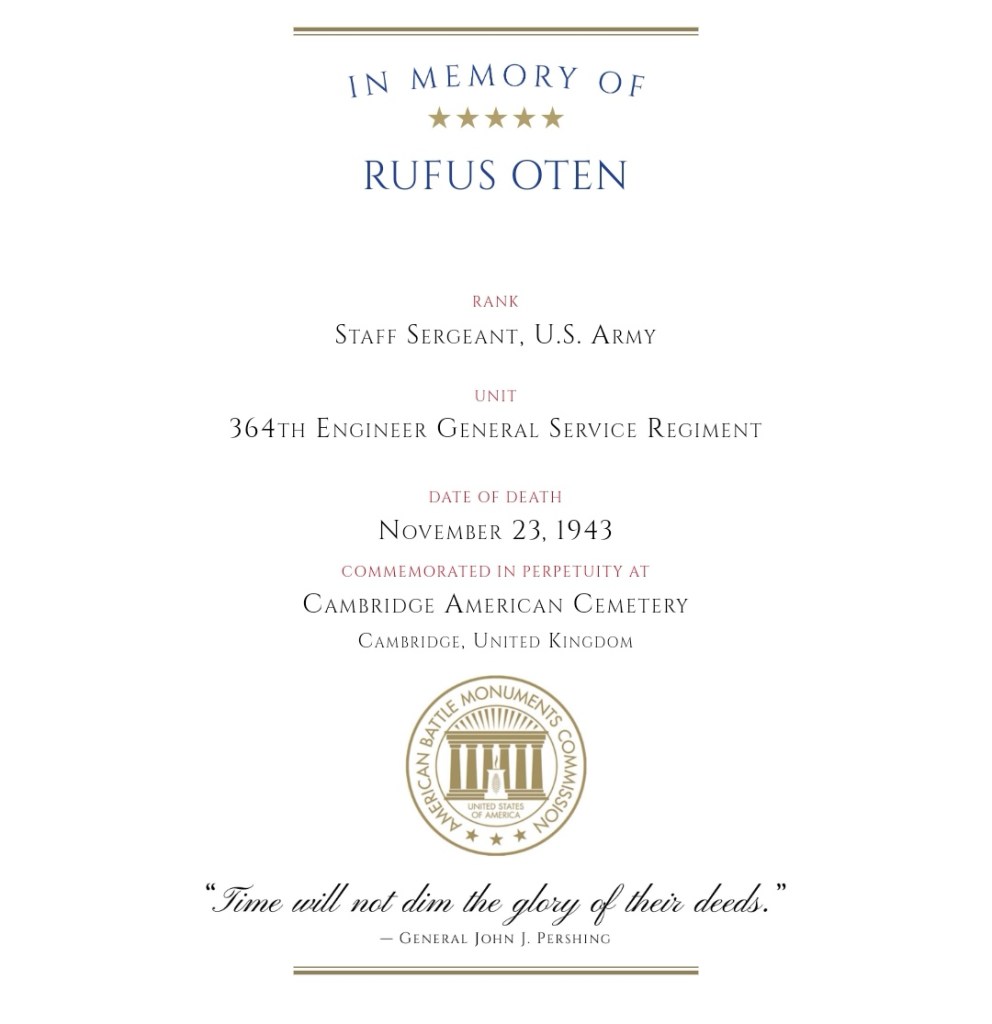
“Time will not dim the glory of their deeds”
General of the Armies John J. Pershing
When the American Battle Monuments Commission was formed in 1923, much like the then Imperial War Graves Commission here, the message was simple: all service personnel who died in the service of their nations would be remembered equally and uniformly ‘in perpetuity.’
In the now several years that I have been involved in studying the commemoration of our fallen, I have always been struck by the great care and solemn reverence applied to those seemingly endless lists of names; especially those whose mortal remains are held in the great cemeteries or recorded upon the memorials to the missing.
I’ve also reflected that although these institutions faithfully record their names, their rank and unit and date of death, so much more information goes unrecorded. The beauty of these records are that they can inspire research into how they died; and as a by-product of military facts, we learn details about how they lived. There are always hidden stories behind what we see when we survey the immaculate massed ranks who reside forever in those silent cities.
If you have read any of my previous blogs, you will know that not only have I told of the men and women from my family history, but also of local tales that might have crossed my path or piqued my interest. One such story from 2021 entitled “The Other Side of the Street” saw me musing about an audio anecdote shared by Ancient House Museum at Thetford; an oral history from a local man called Mark telling his recollections of wartime Norfolk in and around the American camps at Roudham and East Wretham.
While the tales were an insight into the everyday life of a schoolboy and his interactions with the newly arrived Americans, one story in particular stood out; that of the apparent summary execution of a black soldier in an altercation with a white soldier in the street outside Roudham Camp at East Harling.
It didn’t give much detail other than that the victim was a black American, possibly a Sergeant, shot for walking on the wrong side of the road, but it was enough to intrigue me. My late father had been raised in East Harling and had rumoured of a similar incident, and had also spoken of the affinty that formed in the White Hart pub between the locals and the black American visitors. It is a matter of record that the United States Army of 1942 was segregated, and he talked of the US military police taking a dim view of fraternisation between black soldiers and the locals.
The inferences are that when walking to or from the pubs or parties in East Harling, black soldiers were expected to walk on the opposite side of the street to their white counterparts – and that this man had paid with his life for his transgressions. Incredible by modern standards, although unsurprising considering US culture of the time and no less unsettling if true.
My 2021 blog focused on my attempts to identify the victim, and you can read it here:
Having not continued my research for various reasons, you will see that the blog saw me reach the conclusion by a process of elimination that the dead man was likely to be Staff Sergeant Rufus Oten Jr, a 29 year old former cook from Louisiana, who died on Tuesday November 23rd 1943 and who was recorded as a non combatant death.
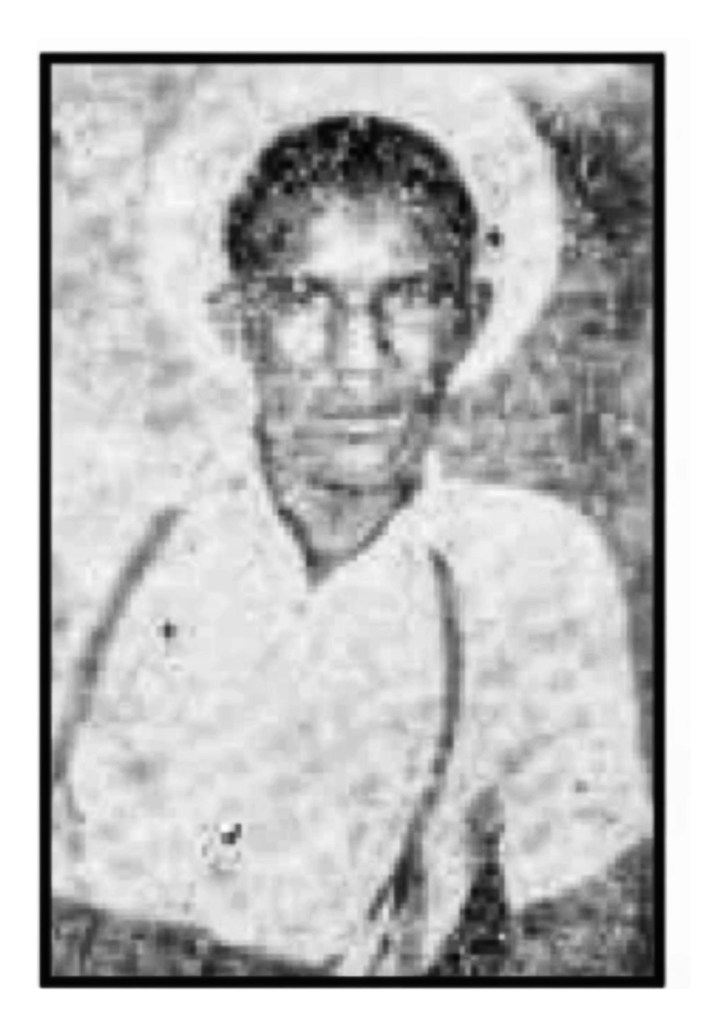
My search terms focused on the black units stationed at Roudham, and men of the correct rank; allowing for the wide margin of error in the source information, this seemed the simplest approach. Using ABMC records to find men of those units, it was possible to quickly narrow it down to just two likely candidates, one of which was Rufus Oten.
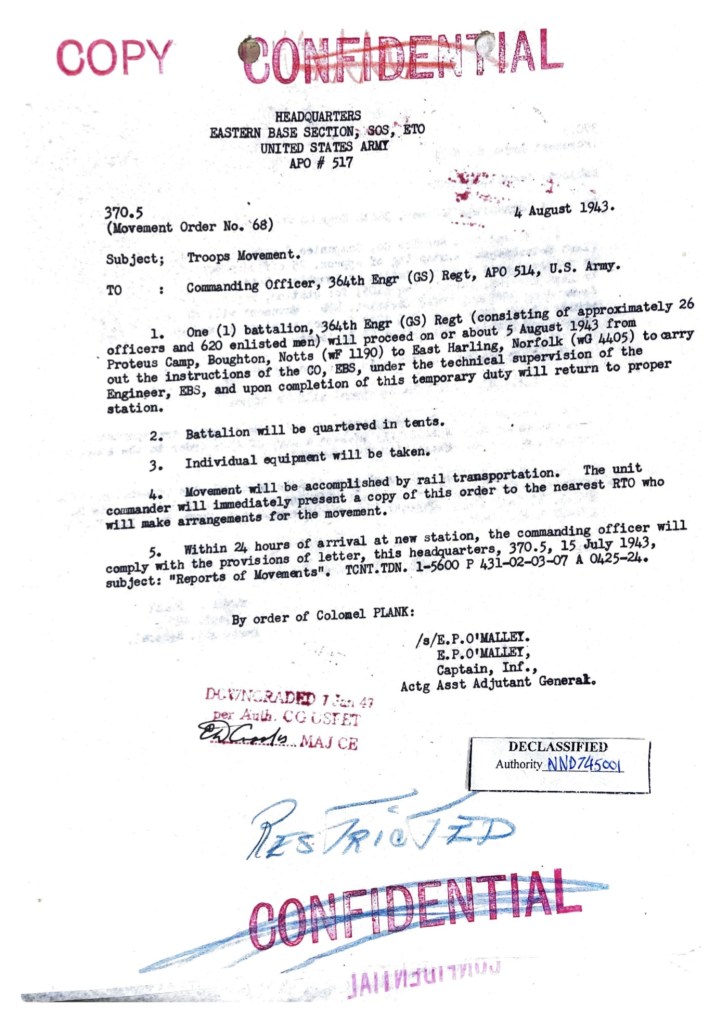
Rufus Oten was attached to the 364th Engineer General Service Regiment – an engineer unit employed in building and maintaining the rapidly expanding number of USAAF airfields and infrastucture springing up across the nation. By a process of elimination, I felt it had to be him.
Post-covid restrictions delayed my request for information from the US National Archives, but the war diaries for the 364th Regiment contained nothing relevant to the time, and focused on their move to France in early 1945. I’d also got other things to focus on until 2023 when I picked up the search again.
A catastrophic US archive fire in 1973 reduced my chances of finding a personnel file, so my hopes relied on an Individual Deceased Personnel File containing enough detail to assist me. With good advice from researcher and author Caitlin DeAngelis, I finally got round to applying for the records for Rufus in June.
Literally all my eggs were in one basket when I sent off my request: If it wasn’t Rufus it could have been almost anyone such was the scant amount of other clues. In my previous career I’d always been taught to go with the available evidence while keeping an open mind; a working hypothesis based on the facts at hand. It felt like I had only one roll of the dice.
I found that half the files were in St Louis, Missouri, the rest in Fort Knox, Kentucky. Applications were sent into the void, but eventually a Freedom of Information request to Fort Knox produced a result. The IDPF for Rufus was efficiently despatched to me by a helpful Army archivist within three weeks of the request.
The files I received were both a revelation and a disappointment in equal measure. Diligently scanned, the file for Rufus Oten contained 45 pages.
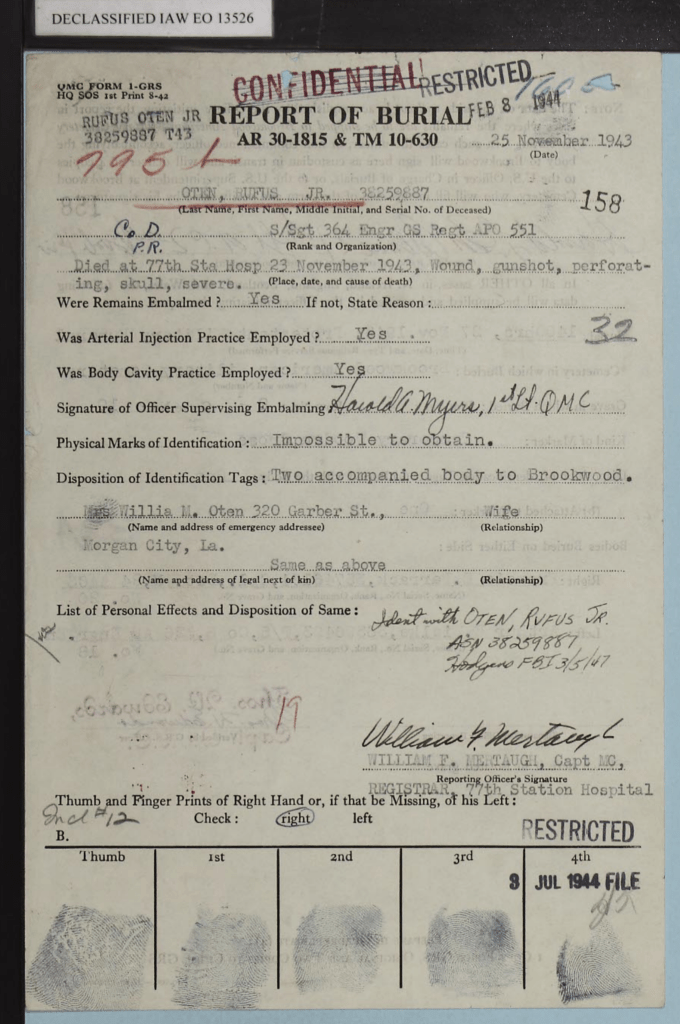
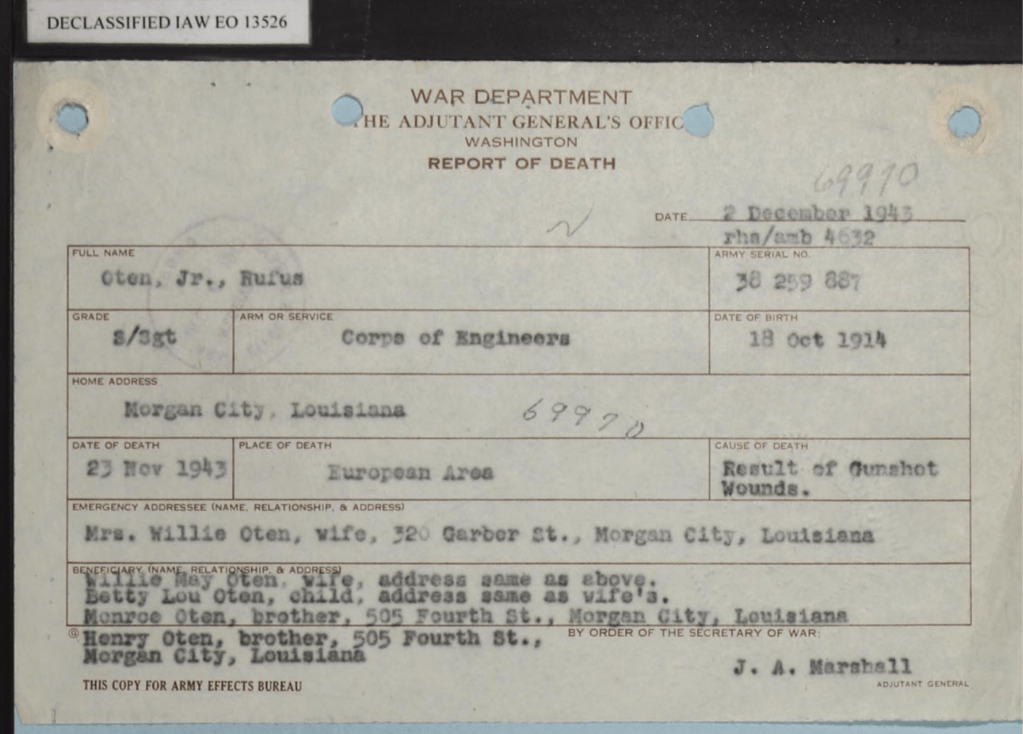
What was immediately apparent was that I had found the right man; or at least it seemed highly unlikely there would be another man dead by gunshot wounds from that unit. Rufus had died on 23rd November 1943 from a gunshot wound to the head, at the newly opened 77th Stationary Hospital at Morley Hall, near Wymondham. Sadly, the burial report contained no narrative around the circumstances of his shooting, or any reference to who else might have been involved; but it felt like his story had reached out to me.
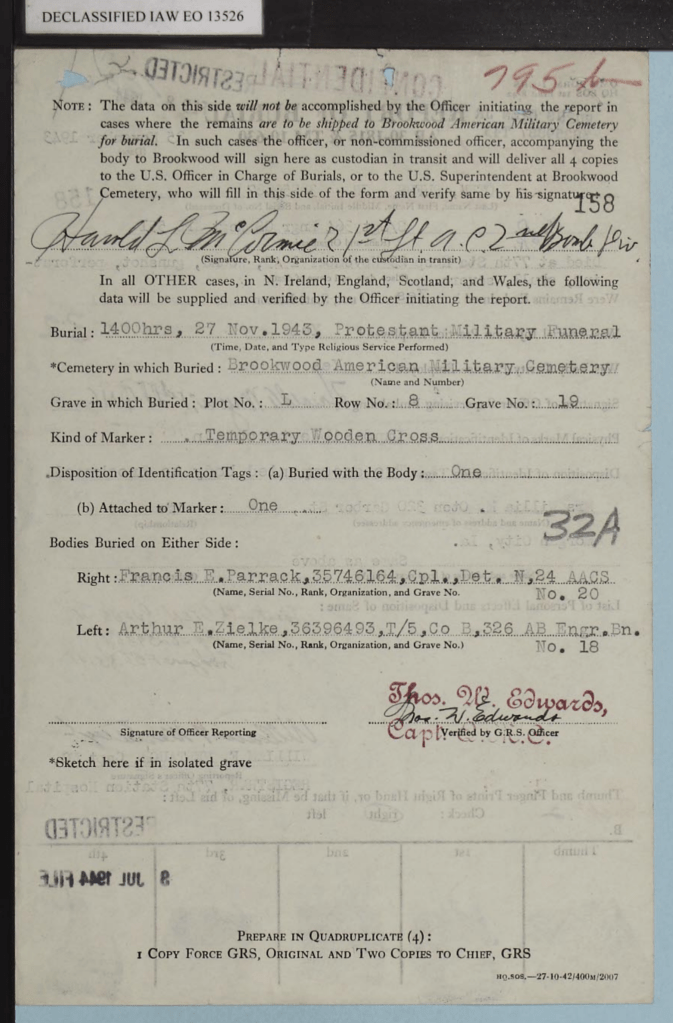
His burial report informs us that Rufus was initially buried in plot L, Row 8, grave 19 at Brookwood cemetery at 2pm just four days later on November 27th. I wonder who mourned him that day.
The remaining documents record his personal effects, and contain a series of letters to his wife Willie Mae.
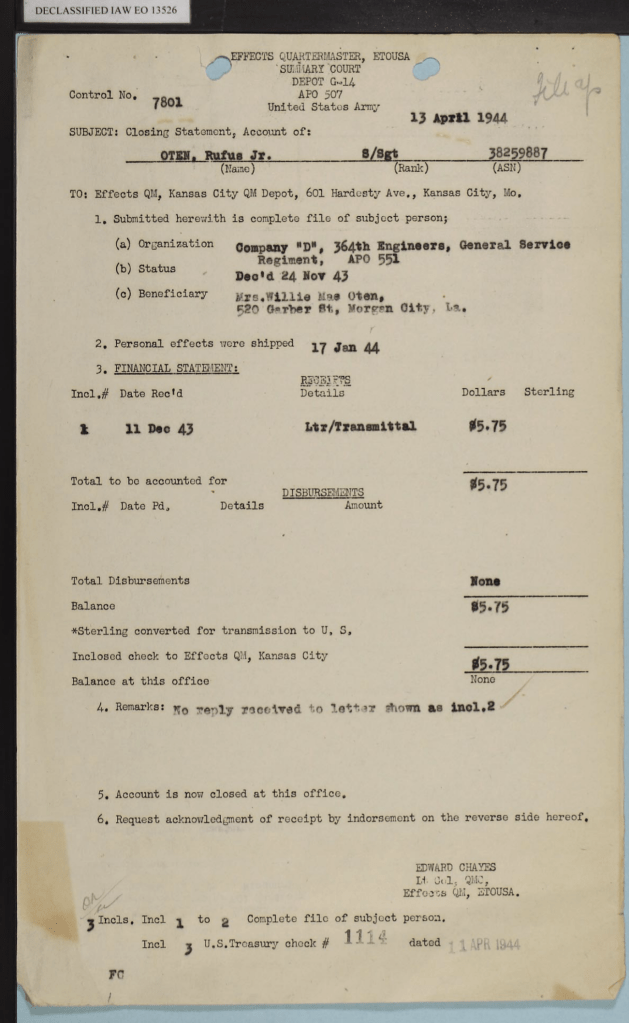
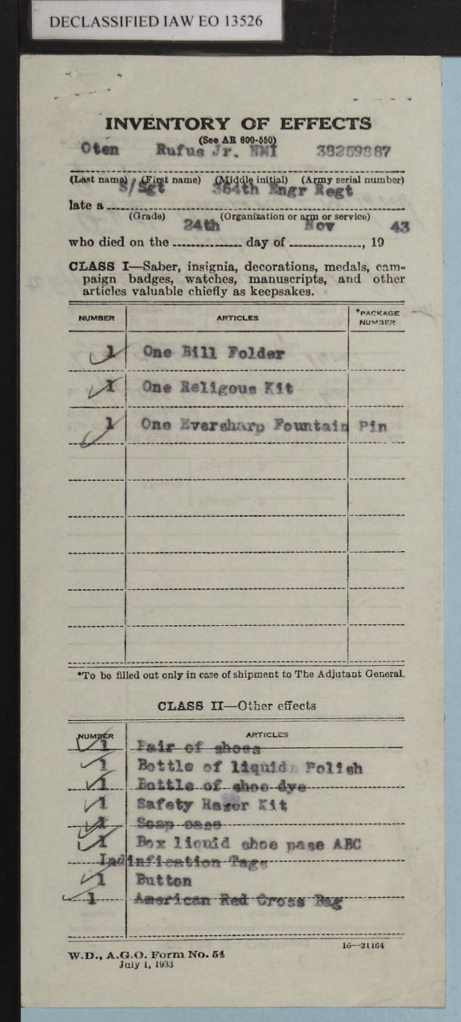
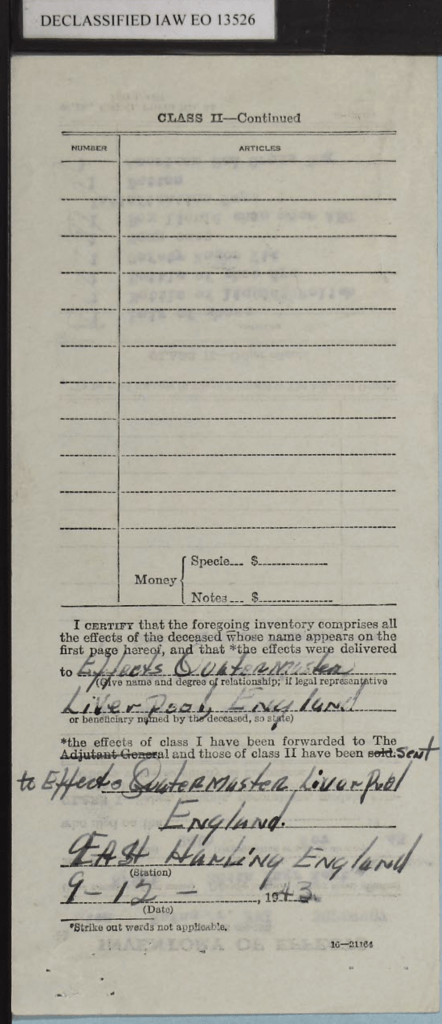
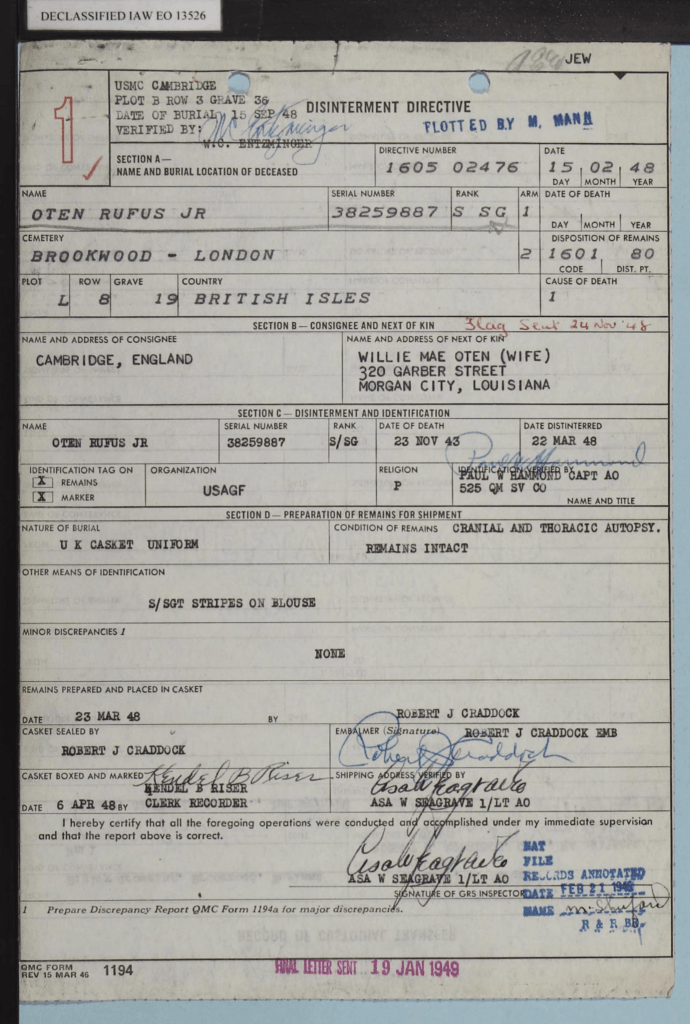
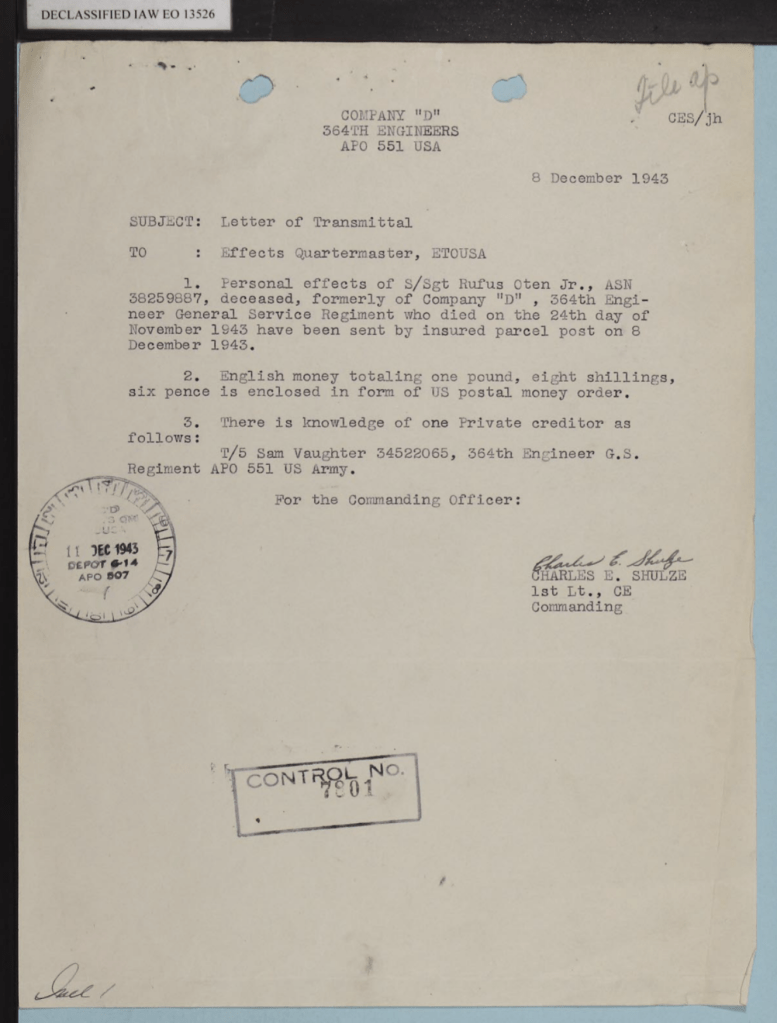
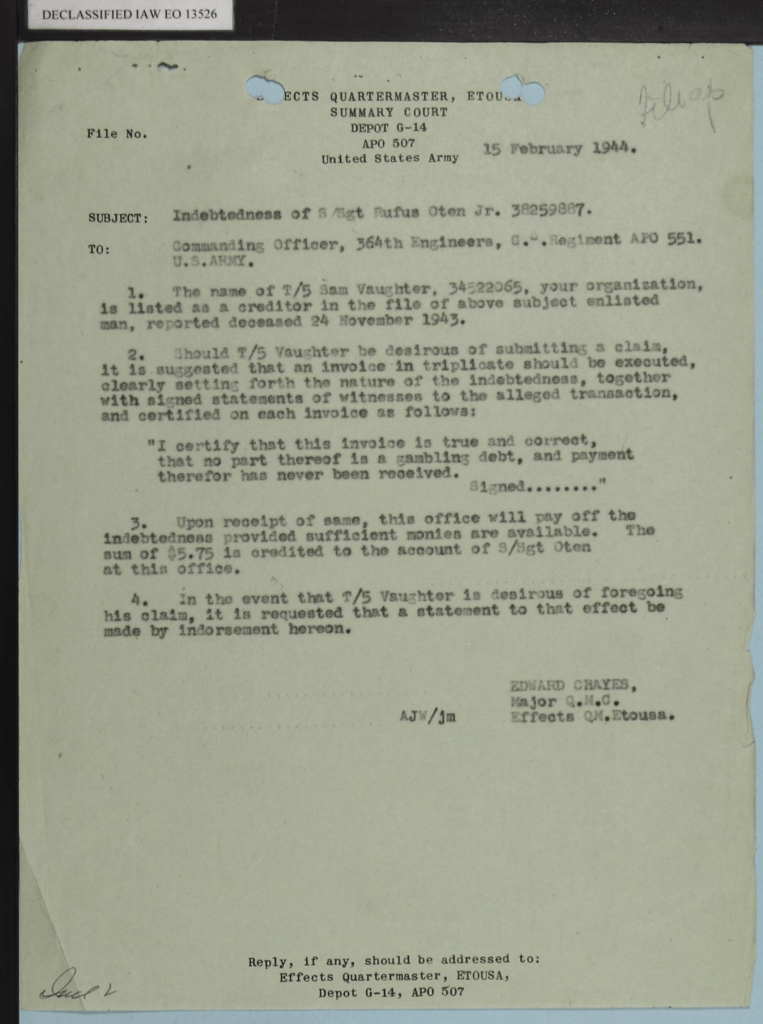
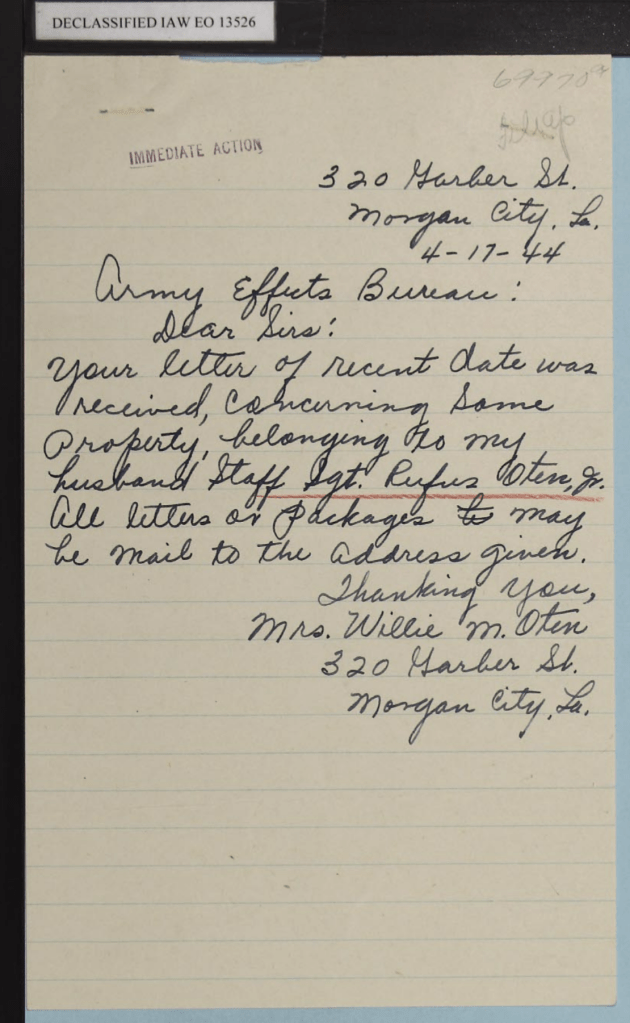
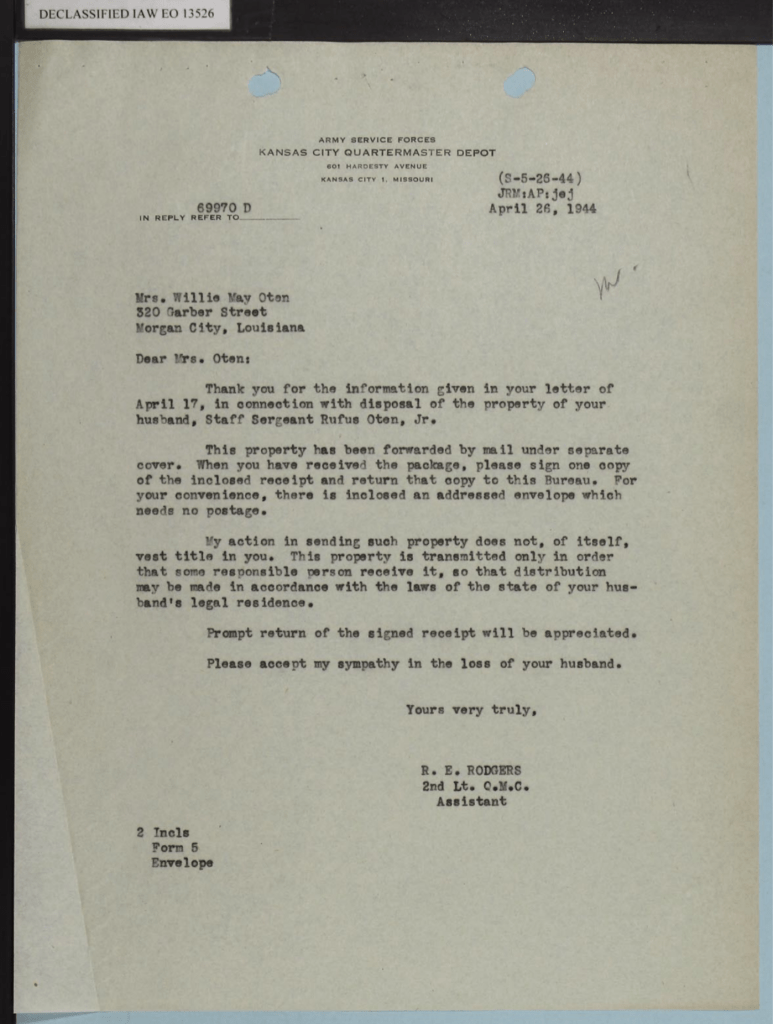
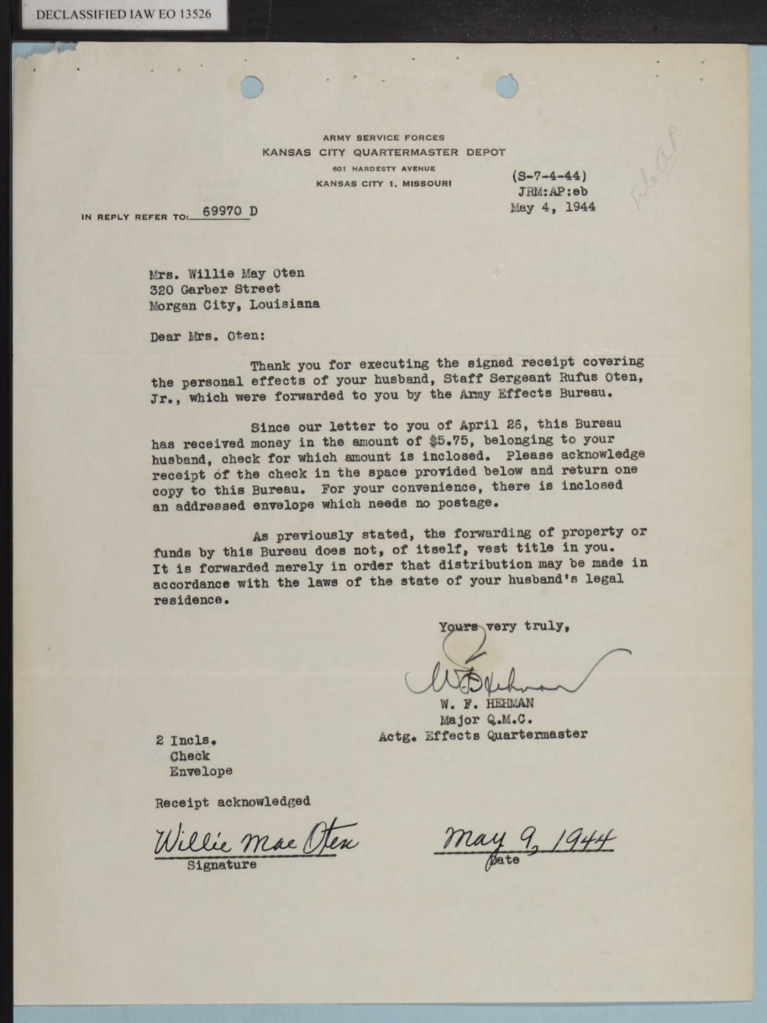
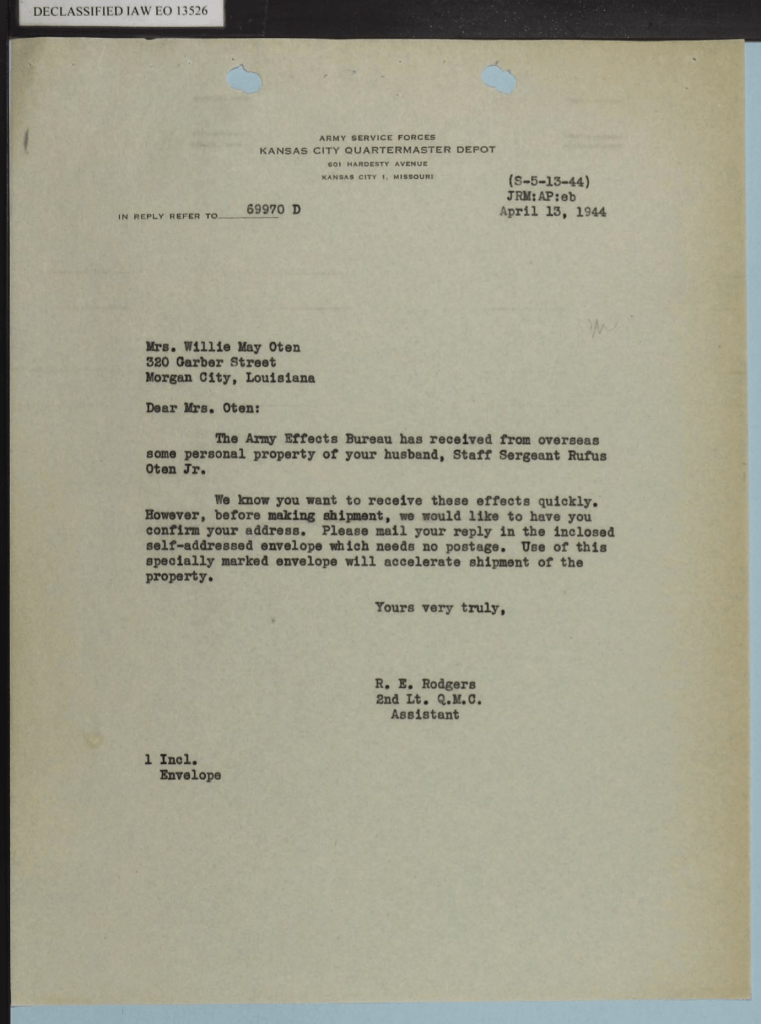
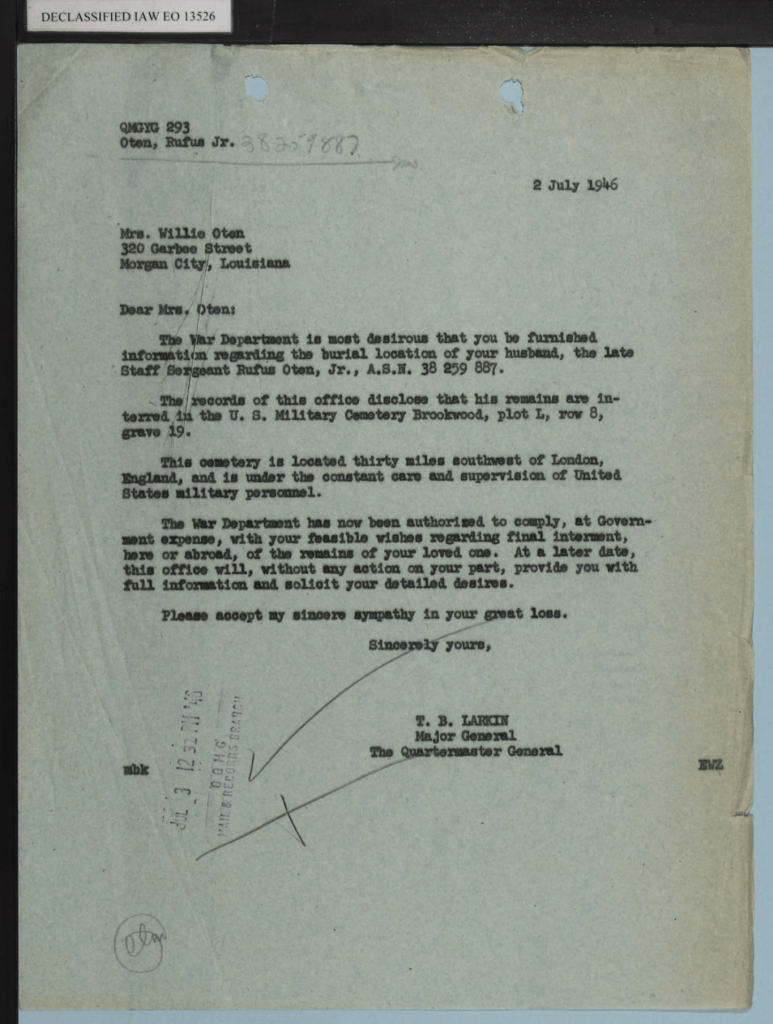
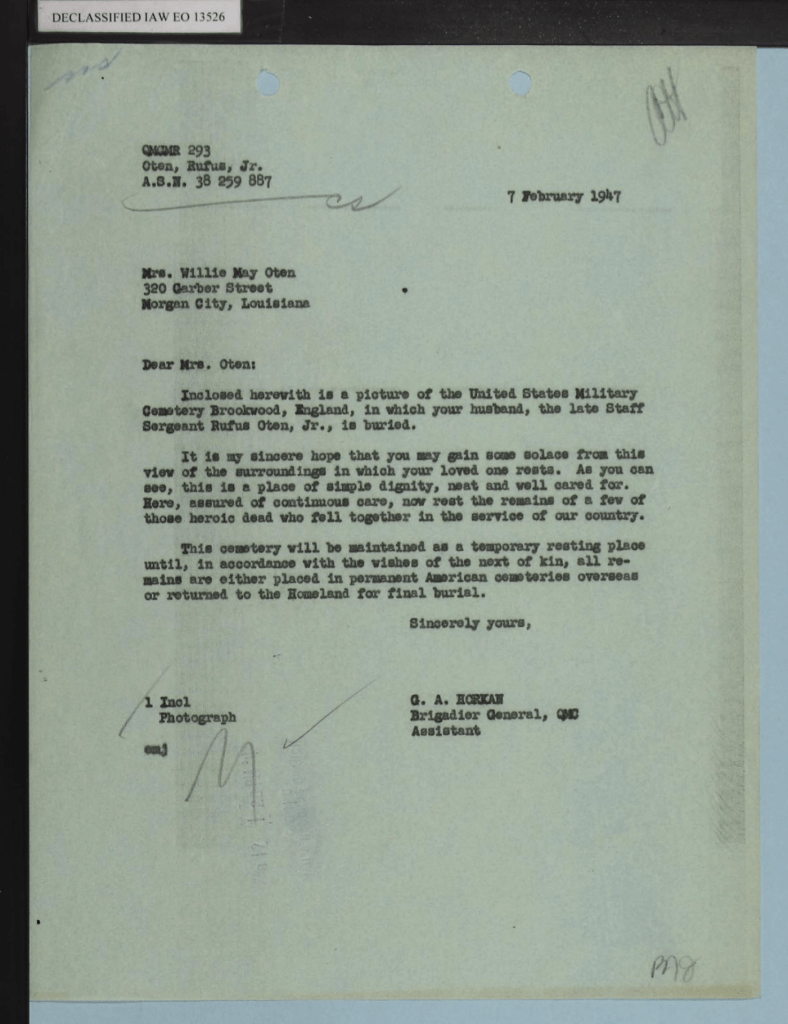
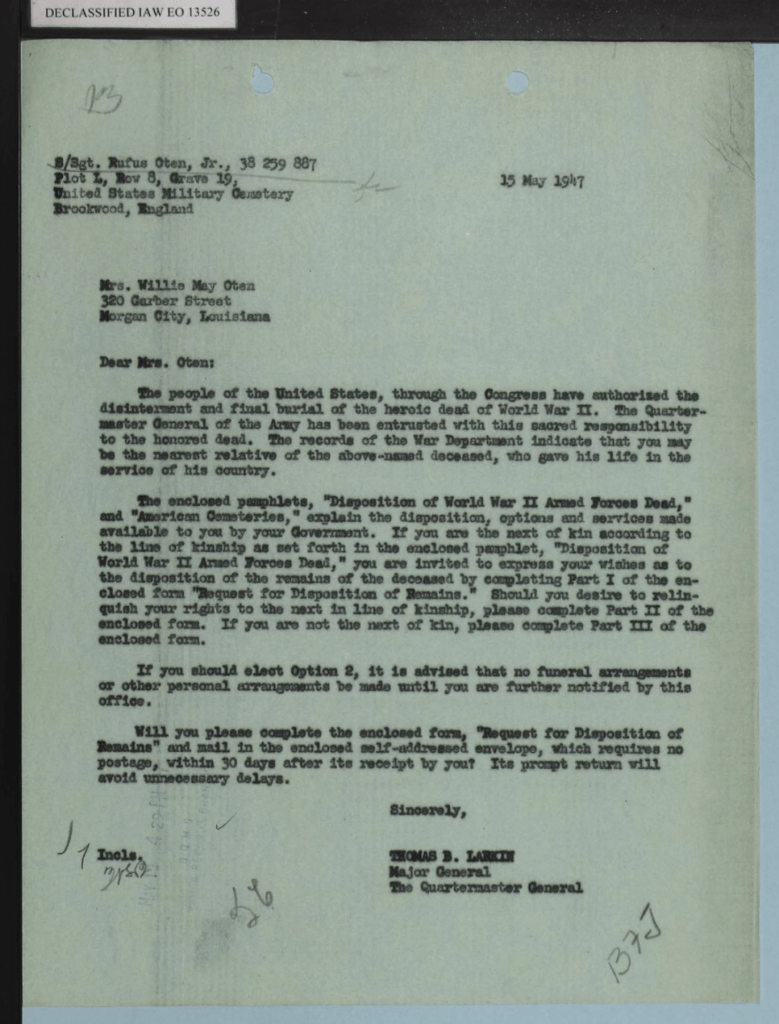
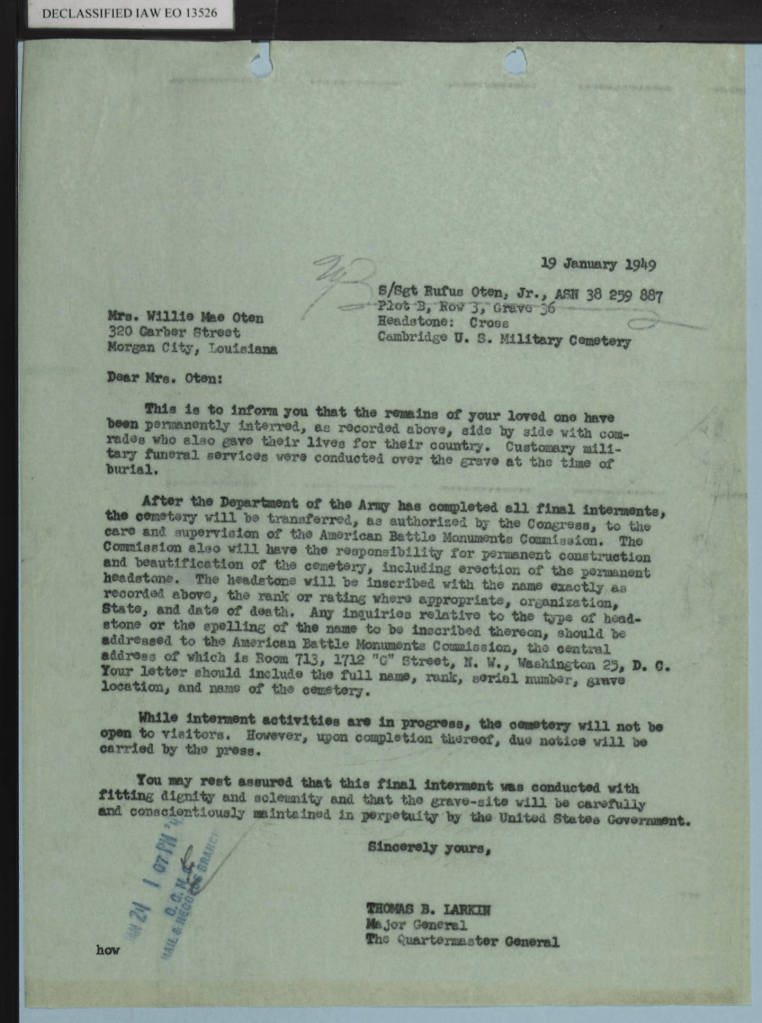
What we learned was that correspondence continued with his widow until 1949, by which time Rufus had been reinterred at Madingley. There is great detail in the documentation describing his transfer from one cemetery to another, even including the names of those involved in the transport of his remains. Many of the letters seem to follow a proforma, full of the service language and platitudes about the ‘heroic dead.’
In some ways, this detail is maddening because it’s almost as if the circumstances of his death are irrelevant or beneath recording. It was time to change that.
There’s no record of Willie Mae being told in explicit terms what happened, and no clue whether she ever knew the truth. The newspaper obituary in the previous blog gives no inference whatsoever that he may have died as a result of a criminal act.
We do though, know more about Rufus.
We know that he was born on October 18th 1914 in Morgan City, Louisiana, and that his widow Willie Mae Oten lived at 320 Garber Street, Morgan City, and that they had a daughter, Betty Lou, who was aged 2 when her father died. Wille Mae had been born in 1919, and lived until November 1993.
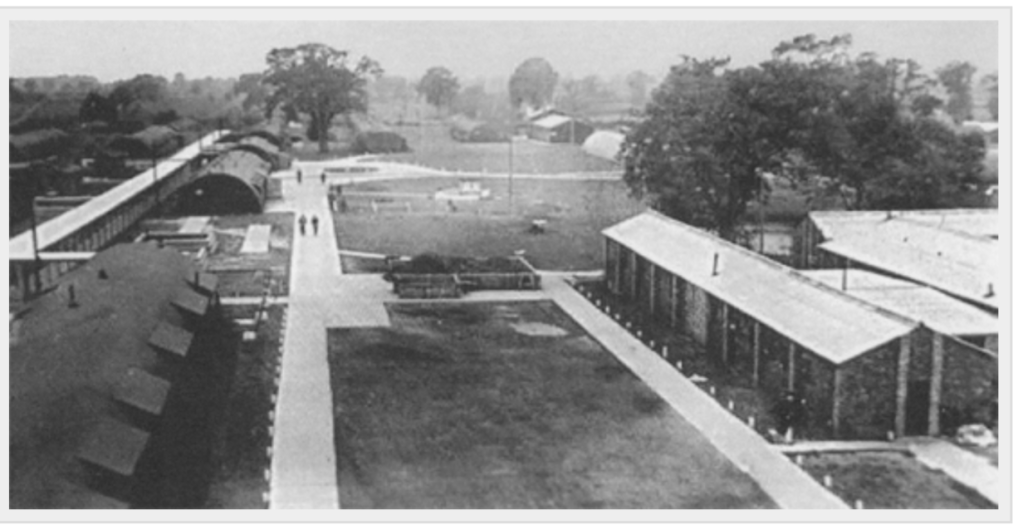
Rufus had enlisted in September 1942 in Lafayette, Louisiana, and was attached to D Company of the 364th Engineer General Service Regiment, a black regiment based at Roudham camp near East Harling. Based on the anecdotes provided by Ancient House Museum and the descriptive corroboration of his cause of death, I am convinced he is that man shot dead on the road near the bungalows at Roudham that still exist today.
I’ve considered suicide, and maybe even an accident, albeit unlikely in an unarmed non combat unit; but overwhelmingly, it is the testimony of a lad from Norfolk that gives weight to the hypothesis that Rufus was the victim of excessive force.
Again I find myself at a roadblock with a lack of information to identify the precise circumstances, or indeed the identity of the perpetrators; but due to a lack of contrary evidence I remain convinced that Rufus was a victim of a gross injustice on that November Norfolk day. The archival silence is deafening.
Undoubtedly, there is much more to be told than I have managed to uncover, but I was determined to give that man a name. Certainly, in the words of General Pershing, time has indeed ‘dimmed their deeds’ or at least dimmed access to the truth, but it seemed an important act of compassion to remember Rufus Oten by name.
It might well be that records have been lost over time, or that the death of a black soldier in a segregated army was unworthy of investigation or report; equally there may have been some investigation that somehow concluded the use of lethal force was justified.
I was given access to the Courts Martial records held in the European Theatre of Operations Judge Advocates Board of Review files; 34 volumes containing c14000 pages of details of US military justice for the entire war – everything from absence without leave to murder.
Having searched the files using a number of parameters, it soon became clear that nobody had faced a criminal sanction for the death of Rufus Oten. Maybe we will never know who pulled the trigger.
We knew little of the facts, but today I hope I have changed that to some degree.
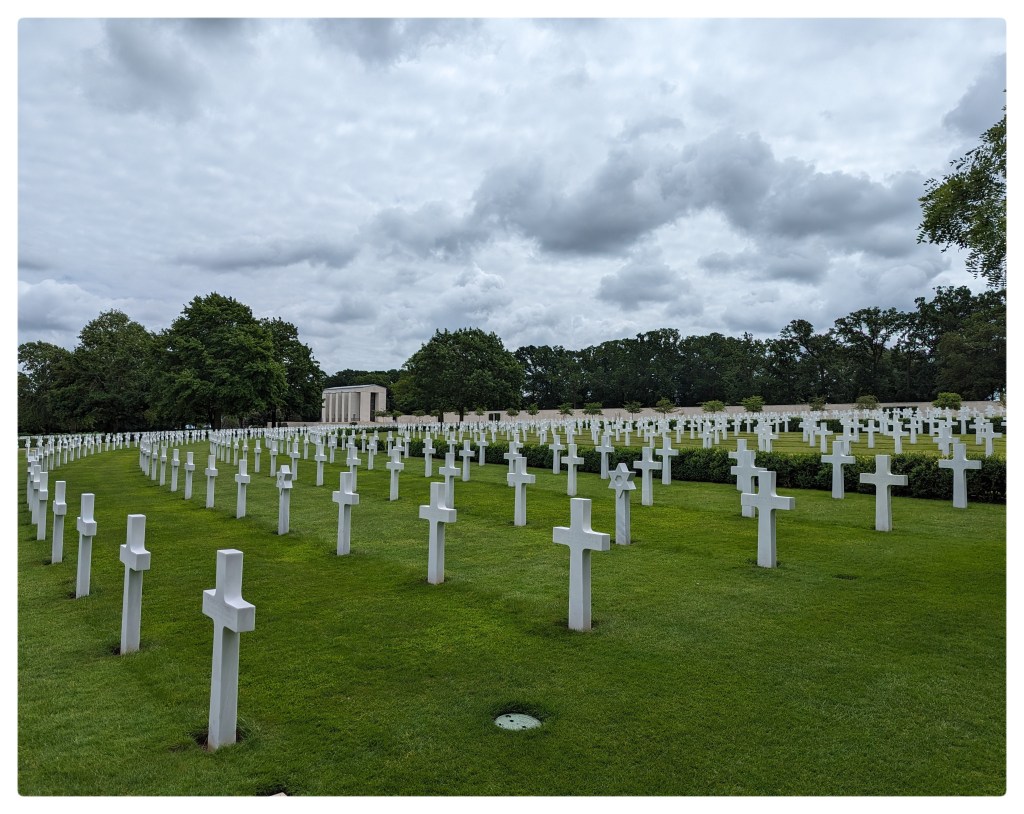
So when you visit Madingley American Cemetery, like all of the great cemeteries of its kind, think upon the headstones and reflect on how they died and wonder; wonder if they were heroes, or wonder if they paid a different price, for there are over 8000 names listed there. Some will be the flyers who earned their glory in the skies. Others are the detritus of war; killed by accident or illness. All are equal in death.
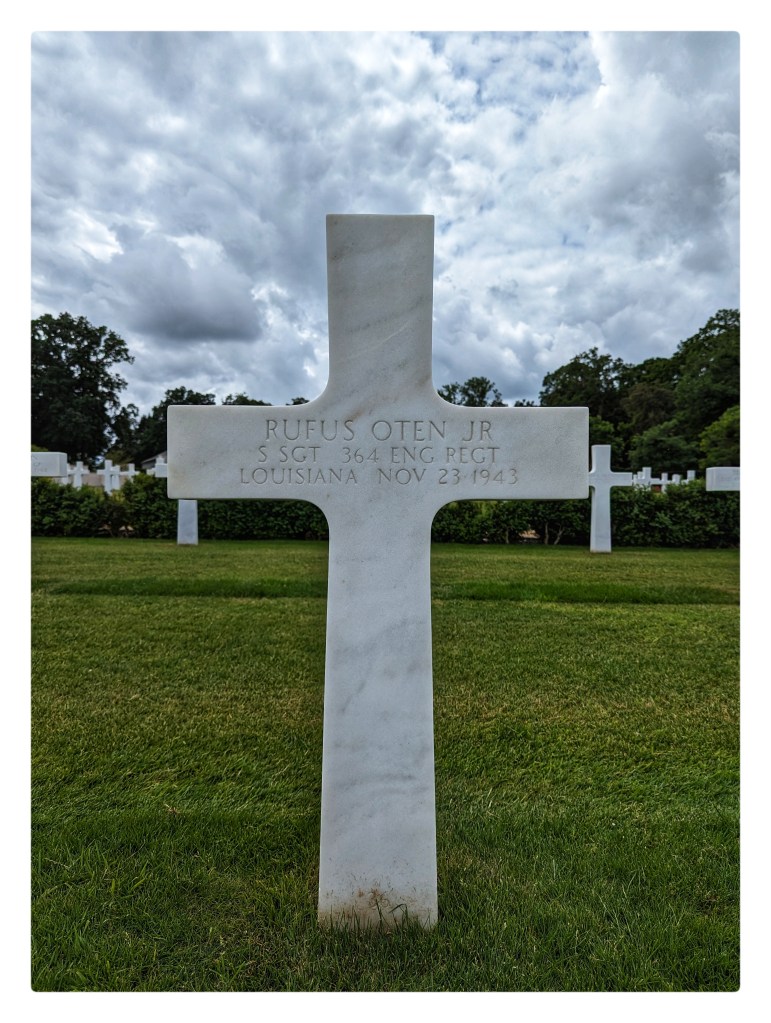
And among the immaculate marble crosses you will find Rufus Oten Jr.
He has always had a name, but today we should say it a little louder – because his story is not an ordinary one, and should not be forgotten.
Dave Cole
July 2023

 Farm Boys and Pioneers